.png)



Introduction
Candidate experience in recruitment has evolved from a “nice-to-have” into a measurable strategic differentiator — shaping employer brand, offer acceptance rates, diversity outcomes, and long-term retention. Yet despite increased investment in technology and process improvement, research consistently shows that most organisations are still falling short of candidate expectations. This article consolidates the latest 2025 statistics, data, and best practices from Gartner, Gallup, Harvard Business Review, and SHRM — to help HR leaders, recruiters, and business executives strengthen every stage of the candidate experience journey and deliver measurable outcomes.
1. Why Candidate Experience in Recruitment Matters: Business Impact
Every interaction — from job discovery to onboarding — shapes the candidate experience in recruitment. In 2025, with increasing adoption of AI screening, automated scheduling, and data-driven matching, the expectations candidates bring to the process have risen alongside the tools available to meet them. Failing to meet those expectations has direct, measurable consequences.
Gallup’s 2025 workforce report reveals that two-thirds of recent hires accepted job offers because of an exceptional or very good recruitment experience. At the same time, SHRM data signals a steady decline in candidate satisfaction since 2021 — indicating a growing gap between what technology makes possible and what most organisations actually deliver across the full candidate experience journey.
Beyond individual metrics, these outcomes compound. A poor candidate experience journey does not just cost you one candidate — it costs you referrals, brand equity, and future applicants who research your reputation before deciding whether to apply. SHRM found that 77% of recruiters struggled to fill roles in 2024 due to mismatched candidate expectations, even as 92% of recruiters remained optimistic about their hiring capacity. That gap — between recruiter confidence and candidate satisfaction — is precisely where AI-driven recruitment automation solutions deliver the most measurable value.
Gallup data shows organisations with strong onboarding and candidate experience achieve 82% higher retention rates and 21% higher profitability. Candidate experience is not a hiring metric alone — it is a long-term performance investment that begins before the first day of employment.
2. Candidate Experience Statistics You Need to Know in 2025
These are the most relevant figures from credible sources to guide your candidate experience in recruitment strategy in 2025. Each data point maps to a specific stage of the hiring process — and a specific opportunity for improvement.
Gartner’s finding that 74% of underrepresented candidates self-select out when they perceive bias is one of the most consequential statistics in recruitment. It means the diversity problem many organisations face is not a pipeline problem — it is a process design problem. Inclusive candidate experience in recruitment, with objective AI candidate screening and structured evaluation, directly expands access to diverse talent pools.
3. What Drives a Better Candidate Experience
Analysis of recent studies from Gartner, Gallup, HBR, and SHRM points consistently to five key drivers of an effective candidate experience journey. These are not independent levers — they reinforce each other across every stage of the hiring process.
Clear, Consistent Communication
76% of candidates cite lack of feedback as a top frustration. Timely, personalised updates at every stage — automated where possible, human where it matters — directly improve offer acceptance rates and reduce drop-off.
Simplicity and Accessibility
Streamlined, mobile-friendly application processes reduce drop-off rates by as much as 40%. Every unnecessary step or form field is a point where a qualified candidate leaves — and does not return.
Fairness and Inclusivity
Objective AI candidate screening with personal identifier masking and inclusive job description design helps mitigate bias at the earliest stages — expanding talent pools and improving the defensibility of hiring decisions.
Onboarding as Part of the Experience
The candidate experience journey does not end at offer acceptance. Effective onboarding directly contributes to the 82% retention improvement Gallup associates with strong candidate experience — making it an integral part of the hiring process, not an afterthought.
Balanced Human + AI Approach
While AI-driven recruitment automation solutions accelerate screening, scheduling, and communication, empathy and human judgment remain essential at the moments that shape candidate perception most — interview conversations, offer delivery, and personalised feedback.
4. Best Practices to Elevate Candidate Experience in Recruitment
These eight practices are drawn directly from the data and research summarised above. Each addresses a specific gap in the typical candidate experience in recruitment and is supported by measurable outcome evidence.
1.Map and Audit the Candidate Journey
Identify specific drop-off points across your application and screening stages. The 60% application abandonment rate (Gartner) is not inevitable — it is a process design problem with a process design solution.
2.Prioritise Communication at Every Stage
Automate status updates and confirmations to eliminate the silence that 52% of candidates cite as the reason they decline offers. Personalise touchpoints — especially at rejection — to protect employer brand with candidates who may reapply or refer others.
3.Embed DEI Principles into Process Design
Write inclusive job descriptions, use structured assessments with objective criteria, and implement AI screening that masks personal identifiers in early evaluation. Closing the 74% diverse candidate self-selection gap requires deliberate process design — not just intention.
4.Use AI Thoughtfully — with Human Oversight
Combine AI-driven recruitment automation solutions with clear human decision points. The 47% of recruiters now using AI in screening (SHRM) are most effective when AI handles volume and consistency, and humans handle judgment and empathy.
5.Integrate Onboarding into the Experience Design
The candidate experience journey does not end at offer acceptance. Seamless onboarding — with clear expectations, early connection to team culture, and structured check-ins — is where the Gallup retention advantage (82% higher) is actually realised.
6.Collect Feedback Continuously
Regular candidate surveys — at application, post-interview, and post-offer stages — identify pain points before they compound. Real-time feedback loops also signal to candidates that your organisation takes the experience seriously.
7.Ensure Pay and Process Transparency
With 74% of candidates expecting pay transparency early in the process (Gartner), organisations that withhold this information are creating a friction point that filters out — or alienates — a majority of their applicants before the first meaningful conversation.
8.Train Recruiters in Empathy and Fairness
Technology optimises the process. Recruiters shape the perception. Empathy and structured fairness training for hiring teams ensures that the human touchpoints in your candidate experience in recruitment are as well-designed as the automated ones.
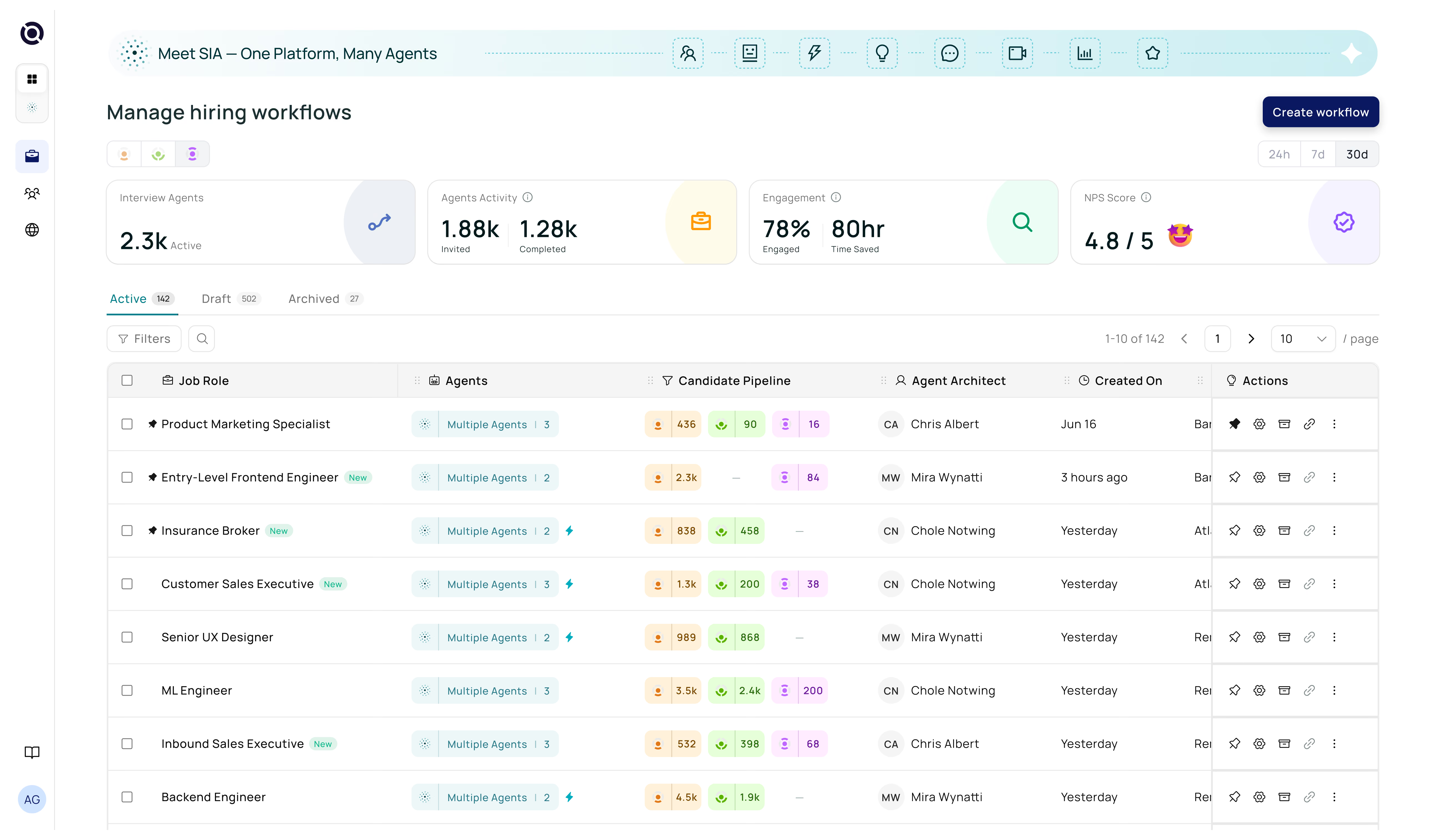
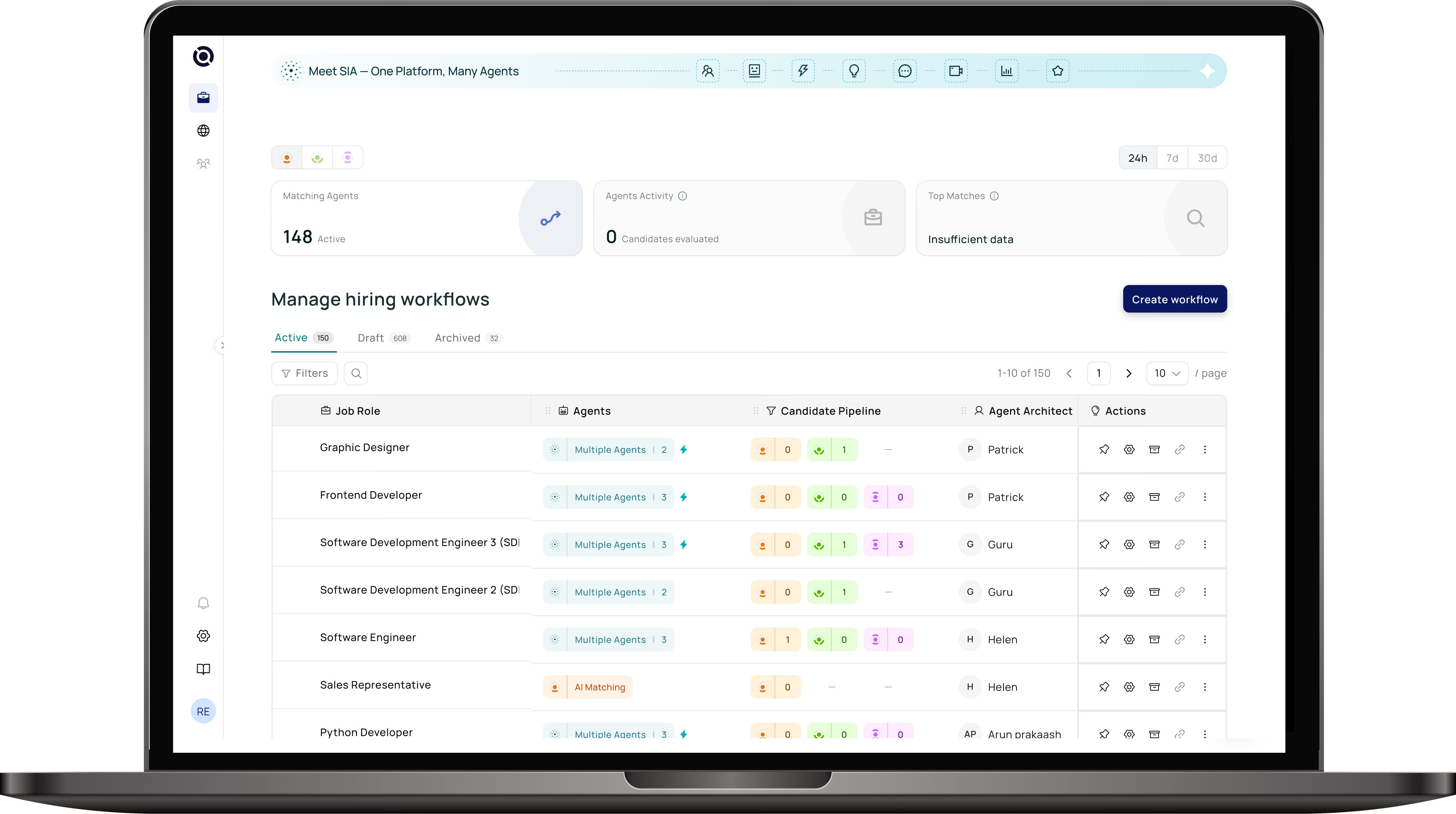
Every statistic in this article represents a fixable process gap. Senseloaf’s AI-driven recruitment automation solutions are built to close these gaps — with transparent AI candidate screening, conversational prescreening, and structured evaluation that keeps humans in control of the moments that matter most. See it in action.
5. The Future of Candidate Experience in Recruitment
As we move further into 2025, candidate experience in recruitment is no longer just an HR concern — it is a strategic business priority with measurable impact on revenue, retention, and employer brand. With only 21% of employees globally reporting high engagement (Gallup), the organisations that design a thoughtful, inclusive, and seamless candidate experience journey gain a compounding competitive advantage in both hiring and retention.
Three forces will define the next phase of candidate experience design:
AI with explainability. As AI-driven recruitment automation solutions become standard, candidates will increasingly expect to understand how and why decisions were made. Organisations that build explainability into their AI screening and matching processes — rather than treating them as black boxes — will earn more candidate trust and satisfy emerging regulatory requirements including the EU AI Act.
Hyper-personalisation at scale. The tension between high-volume hiring efficiency and personalised candidate engagement is dissolving. Agentic AI systems that adapt prescreening conversations to individual candidate profiles, role contexts, and communication preferences are making genuine personalisation possible at any volume — without additional recruiter workload.
Experience continuity from application to onboarding. The organisations performing best on both candidate satisfaction and retention metrics are the ones treating the full journey — from first application to 90-day onboarding — as a single, continuous experience design problem. The data from Gallup is clear: the retention advantage belongs to organisations that do not treat hiring and onboarding as separate functions.
The most impactful first step is usually the simplest: audit your current process for the three most common drop-off points — application complexity, communication silence between stages, and interview scheduling friction. Addressing these three alone will close a significant portion of the candidate experience gap that the SHRM data documents. From there, AI-driven recruitment automation can scale the improvements without scaling recruiter workload.
Topics Covered in This Article
Ready to improve your candidate experience journey? Benchmark your current process or explore how Senseloaf’s AI-driven recruitment automation can help you deliver a better candidate experience at every stage — from application to onboarding.